Flexe Discover: Find warehouse capacity, benchmark pricing and prove ROI. Explore Now
Articles

Navigating the Shift: Strategic Inventory Pull-Forward in a Volatile Tariff Landscape

Don’t let shifting trade policies erode your profitability. Use the Flexe Spot Warehousing Index to transform warehousing into a variable asset, securing on-demand capacity at market-validated rates before potential tariff jumps take effect. This article models some hypothetical risk scenarios to help you stress-test your supply chain in advance of potential tariff increases.*

Key Takeaways

  • Beat the Clock: Import early before potential tariff increases. Below, we’ve modeled some hypothetical risk scenarios of +15% to +50% tariff increases to show the potential impact on your supply chain.
  • Variable Asset: Use the Index to transform rigid, fixed-lease warehousing into a flexible, variable asset.
  • Potential Savings: The cost of utilizing on-demand storage can be significantly lower than the expense of absorbing a 15% or higher tariff increase.

The April 2026 Tariff Reality Check

The shifting geopolitical and economic landscape, marked by the Trump administration’s “two-stage” strategy to replace an estimated $175 billion in duties collected from voided IEEPA tariffs, has created a narrow but critical window for businesses to protect their bottom lines. A new, aggressive tariff replacement plan is rapidly unfolding:

  • Immediate Surcharges: A 10% universal tariff rate is currently in effect under Section 122 of the Trade Act of 1974. A formal proclamation may raise this to 15%, the statutory maximum under the Trade Act. These surcharges are limited to a 150 day window without an act of Congress.
  • Accelerated Section 301 Investigations: In the wake of invalid IEEPA “Reciprocal Tariffs” the USTR has initiated new investigations into harm on U.S. industry and are targeting foreign industrial manufacturing, digital services, and forced labor in supply chains, with target scenarios ranging from 15% to 50%, based on the Trump administration’s historic practices and depending on the specific HTS code and country of origin.
  • National Security Tariffs (Section 232): The administration is continuing to utilize the Section 232 authority (which was not struck down by the U.S. Supreme Court) to apply tariffs to additional industrial sectors. Expanded investigations into batteries, chemicals, and metals are being modeled by analysts at a baseline of 25% – consistent with the administration’s recent Section 232 semiconductor order (see White & Case, January 2026), though these duties are already in effect for many products under existing Section 232 and 301 tranches and the March 2026 investigations are still in the public comment phase.

The question for importers is which inventory is worth pulling forward now to avoid the potential hit.

A Formula to Stress-Test Your Pull-Forward Decision

To determine if pulling forward inventory makes financial sense, organizations can compare the cost of new potential tariffs against the cost of holding that inventory for the duration of the “stop-gap” period (for this exercise we are assuming bringing in 8 months’ worth of inventory).

V x C x T > (S + (C x i)) x M

  • V x C x T: Total tariff spend, where…
    • V: Volume: (# of pallets)
    • C: Pallet COGS
    • T: Tariff Rate
  • (S + (C x i)) x M: Total inventory holding cost, where…
    • S: Monthly pallet storage cost (The Flexe Index benchmark)
    • C x i: Monthly carrying cost (Inventory Value x Interest/Insurance rate)
    • M: Months held before sale

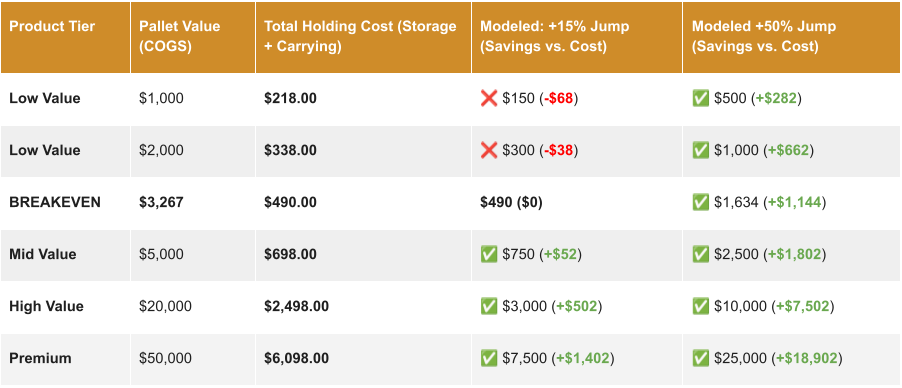
The Pull-Forward ROI Decision Matrix (8-Month Window)

Assumptions: 8-month hold period; $12.25/month storage (Flexe Spot Warehousing Index rate as of April 2026); 1.5% monthly carrying cost.

Note on Strategy: This matrix uses modeled risk scenarios as a decision-making framework. Because most duties are specific to HTS codes and countries of origin, shippers can apply this formula to their unique risk profile. Modeled Jumps are calculated as incremental increases over the current 10% Section 122 baseline. For example, a +50% jump illustrates a hypothetical scenario where a 50% incremental tariff is layered on top of the current 10% baseline, resulting in a 60% total duty. This scenario is informed by rates proposed under prior executive orders across tariff programs and targets currently under investigation for high-risk categories in the 2026 Section 301 proceedings.

Stop guessing which pallets to pull. Input your COGS and tariff risk to see your specific breakeven window.

Understanding the “Indifference Point”

The $3,267 figure in our matrix identifies the “Indifference Point” or breakeven for a scenario where new tariffs increase costs by +15%. This is the estimated per pallet COGS value where the cost of doing nothing (for example, paying a modeled 25% total new duty under a Section 301 or 232 basis, assuming expiration of the Section 122 tariff rate and a general duty rate of 0%) is approximately equal to the cost of taking action (storing inventory now). At this pallet value, the 15% you save in tariffs is offset by the $490 in combined storage and carrying costs over 8 months.

The Math Behind the Threshold:

  • The 3% “Savings Buffer”: Since your 8-month carrying cost is 12% (1.5% x 8), and the savings is 15%, you have a 3% margin to cover physical storage.
  • The Calculation: To cover $98 in storage fees ($12.25 x 8 months) using that 3% margin, your pallet must be worth at least $3,267.

Strategic Takeaways

  1. Prioritize by Density of Value: High-Density Value goods (Consumer Electronics, Pharma, Apparel) may easily clear the $3,267 per pallet COGS threshold, making them primary candidates for pull-forward. Low-Density Value goods (Bulk Paper, Low-Cost CPG) are often more cost-effective to import as-needed, even with additional tariffs.
  2. Section 301 Scenarios Strongly Favor Action: If your goods fall under the high-impact USTR sector-specific investigations, the math shifts dramatically. At a modeled +50% jump (representing a move from the universal 10% rate to a hypothetical 60% high-risk scenario for specific targeted goods), storage costs represent a small fraction of the tariff exposure, and the pull-forward case clears the breakeven threshold for a wide range of SKUs. Readers should verify whether their specific HTS codes are covered before acting.
  3. The Flexe Advantage: A pull-forward is a short-term tactic, not a long-term need. Flexe allows you to duration-match your storage to your risk. You get the space you need for the temporary bridge to beat the tariff jump, without being anchored to a multi-year lease after the inventory clears.

Next Steps for Your Supply Chain

As the 150-day clock on current surcharges continues to tick, proactive planning is essential.

  • Evaluate Market Conditions: Use the Market Insights Dashboard to monitor the Flexe Spot Warehousing Index and validate pricing against a data-driven standard.
  • Explore Available Capacity: Utilize Warehouse Search to identify space in your target markets and stay ahead of shifting trade policies.

Don’t wait for the next wave of tariffs to take effect. Help protect your margins today by leveraging the Flexe Spot Warehousing Index to benchmark flexible warehousing storage costs.

*Tariff rates and timelines discussed in this article reflect current proposals and publicly available information as of April 2, 2026. Actual rates, affected countries, and covered product categories may differ from those described here. The risk scenarios modeled in this article (e.g., +15% and +50% tariff jumps) are estimates based on rates imposed under prior executive orders, including reciprocal tariffs of up to 50% under Executive Order 14257 (April 2, 2025), which are no longer in effect. These scenarios are illustrative and do not represent current or confirmed future tariff rates. Businesses should consult a licensed customs broker or trade counsel to assess the specific impact on their supply chains based on product HTS classifications and countries of origin.

Explore Flexible Warehousing Insights Now

Warehouse Solutions

Transform your supply chain with an asset-light, agile approach

Save OpEx with Flexe

Stop overpaying. Calculate estimated savings by switching from rigid long-term leases to a pay-as-you-go model.

How It Works

A Dynamic Business Needs a Dynamic Supply Chain

Flexible Warehouse Network

Instantly find locations and specialized providers to optimize your inventory and handle the unpredictable.

Market Insights

Supply Chain Intelligence

Access market trends, vacancy rates, site costs, and capabilities to pinpoint your next strategic move.

Who We Are

Subscribe to
Flexe Resources

Get new posts delivered to your inbox.

Sign up to be part of the Flexe Logistics Network. Flexe Resources