Executive Summary: The 20% Resilience Buffer
The freight market has long relied on a mix of contract and spot capacity to balance cost efficiency with flexibility. We apply that same logic to warehousing, with what we call Flexe’s 80/20 rule: keep your core, predictable volume in fixed contracts, and reserve a flexible layer to absorb variability.
In an era of “Permanent Volatility,” relying on a 100% fixed-lease network is no longer a viable strategy, it creates “dead air” costs during lulls and bottlenecks during peaks. We recommend a hybrid model, 80% Fixed Infrastructure and 20% Flexible Capacity, that gives organizations a path from a rigid liability to a competitive, “offensive” asset.
Flexe provides the transactional infrastructure and market intelligence to operationalize this model, allowing shippers to benchmark, scale, and de-risk their networks with the same precision they bring to the freight market.
The Freight Market Parallel: Why 20% is Warehousing’s “Goldilocks Zone”
The warehousing market typically follows freight market trends with a 3–6 month lag. Freight has long balanced fixed and flexible capacity, just not at an even 80/20 split: according to DAT Freight & Analytics, contract freight typically runs 80-90% of truckload volume, with spot freight historically closer to 10-15% in a normal market, spiking to as much as 25% during acute capacity crunches like 2021. Even at that lower baseline, the lesson holds:
- 80-90% Contracted (The Core): Shippers move the majority of volume via fixed-rate contracts to ensure routing guide stability. This is the “Everyday Low Price” logistics layer.
- 10-15%+ Spot (The Valve): The spot market acts as a release valve for one-off lanes or when a contracted carrier rejects a load, expanding well beyond that baseline (up to ~25%) when the market tightens.
Flexe recommends sizing warehousing’s flexible layer a bit larger, at 20%, because warehouse volatility compounds on that 3–6 month lag and lease terms are far less liquid than freight capacity. It’s a Flexe-recommended target for warehousing, not a claim that 20% mirrors today’s freight market exactly.
Fluctuation Drivers: Why the market shifts
The spot freight market is highly volatile, with rates changing daily based on real-time supply and demand. Key reasons for these fluctuations include:
- Capacity Tightness: When the number of available trucks decreases, due to carrier exits or high demand, spot rates spike as shippers compete for limited space.
- Market Disruptions: Events like port strikes, extreme weather, or sudden economic shifts can cause a “cascade of failure” where contract carriers reject loads for higher-paying spot opportunities.
- Economic Cycles: In a “Soft Market,” capacity is abundant and spot rates may fall below contract rates; in a “Tight Market,” the ratio can flip to a 70/30 split as more volume “leaks” into the spot market due to contract failures.
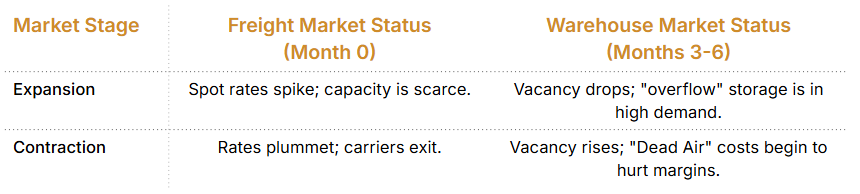
Because warehousing is the physical destination for freight, these transport fluctuations create a ‘bullwhip effect’ that hits the warehouse 3–6 months later. An 80/20 warehouse split is the most effective way to absorb that delayed impact.
Correlation to Warehousing Trends
The transition from 100% fixed networks to an 80/20 hybrid model in warehousing mirrors the evolution of freight for several key reasons:
- From Defensive to Offensive Strategy: Just as freight’s flexible buffer provides the “elasticity” to handle disruptions, a 20% warehousing buffer allows for Geographic Agility, placing inventory closer to customers exactly when needed.
- Eliminating Inefficiency: In freight, relying 100% on contracts can lead to overpaying when the market softens. In warehousing, 100% fixed leases lead to “Dead Air” spend on empty racks.
- Data-Driven Standard: Flexe recommends the 20% Rule as the new benchmark for warehousing because tools like Flexe Discover now provide the same level of market intelligence and benchmarking power that has existed in the spot freight market for years, intelligence that makes a variable-capacity strategy actionable for the first time.
Summary of the Correlation
Mastering the 80/20 Rule for warehousing
Here’s what the 80/20 model looks like in practice: instead of leasing for 100% of projected peak capacity, Flexe recommends a more resilient split, 80% fixed, 20% flexible, between core and buffer capacity.
- 80% Baseline (Fixed): Maintain your core network through traditional, long-term leases or dedicated 3PL facilities.
- 20% Buffer (Variable): Leverage flexible warehousing to manage the final 20% of your volume, seasonal peaks, overflow inventory and short-term regional fluctuations.
Scenario: A 100,000-Pallet Network
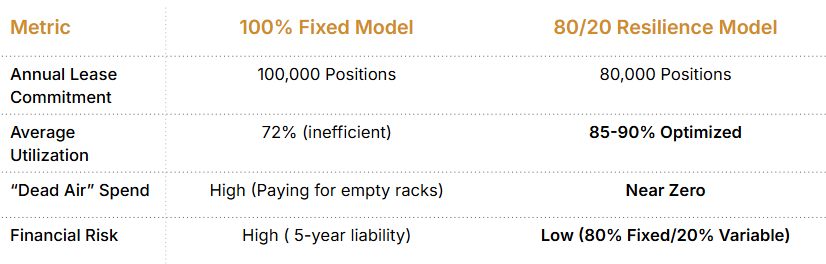
- The Traditional Model (100% Fixed): You lease for your 100k peak. Even when you only have 70k pallets in Q1, you are paying for the “Dead Air” of 30k empty positions.
- The Resilience Model (80% Fixed / 20% Flexible): You lease for 80k. You keep those buildings at 85-90% utilization (the most efficient way to run a warehouse). The remaining 20k pallets are handled via flexible warehousing only when they exist.

Why the Buffer Matters
Why focus on just 20%? Because that final slice of capacity is often the most expensive to maintain and the most vulnerable to external shocks. By shifting this “top slice” to a transactional, usage-based model, shippers realize three immediate strategic advantages:
- Eliminating “Dead Air” Costs: When you lease for peak, you pay for empty racks for the majority of the year. By using the 80/20 Rule, you only pay for that capacity when inventory is actually in the building. You convert a rigid real estate liability into a variable operational expense that scales with your actual throughput.
- Supply Agility: Fixed leases anchor your inventory to a static coordinate, creating a single point of failure in your supply chain. While demand is often national, supply shocks, such as port strikes, tariff shifts, or canal blockages, are inherently geographic. The 20% buffer allows you to shift your “center of gravity” away from these bottlenecks. If a labor dispute shutters your primary West Coast port, you don’t wait for the backlog to clear; you spin up a flexible node near an alternative port of entry and bypass the disruption entirely.
- Financial Resilience: In an economic downturn, a fixed lease is a weight on the balance sheet. With a 20% flexible buffer, your network is “self-righting.” If demand drops or a specific trade lane becomes unviable, you simply stop booking flexible space. This allows you to immediately reduce your burn rate and reallocate capital without the legal and financial headache of a lease exit.
From Theory to Execution: Flexe Discover
The reason a flexible-capacity strategy is only now within reach for warehousing is that, until recently, the data didn’t exist to execute it.
Through Flexe Discover, get the same type of benchmarking power and market intelligence to warehousing much like the spot freight market. Shippers can now use our proprietary Spot Warehousing Index to monitor on-demand pricing and demand intensity nationally and regionally, vacancy rates and market sentiment, giving them the confidence to move away from total lease dependence.
Moving from Defensive to Offensive
The 80/20 Rule isn’t about replacing your network; it’s about right-sizing it through modern warehousing solutions. It’s a shift from “just-in-case” real estate, where you pay for space you might never use, to “just-in-time” infrastructure. By shifting 20% of your footprint to a flexible model, you eliminate the “dead air” costs that traditionally erode logistics margins during market lulls.
In the wake of Q1’s global disruptions, the industry has reached a turning point: the most resilient supply chains are no longer those with the most square footage, but those with the highest degree of network fluidity. By decoupling growth from fixed-lease constraints, market leaders are ensuring that their ability to deliver is never anchored to a single point of geographic failure.