Flexe Discover: Find warehouse capacity, benchmark pricing and prove ROI. Explore Now
Articles

Flexe Institute Market Watch: M&A Activity Increasing Across Industries

Mergers and acquisitions present significant growth opportunities.
Market-Watch_Collage_May2022
And several supply chain challenges.

Key Takeaways

  • 9% above pre-pandemic levels in 2022 for M&A deal volumes
  • 7% higher shareholder returns for M&As that occur during a downturn
  • 75% of M&A volume among top consumer goods companies are non-enterprise brand deals
  • 66% of executives saw M&As producing disruptions in product launches
  • 50%+ observed problems with filling orders
  • 30%+ reported inventory issues

Mergers and acquisitions (M&A) typically decrease during uncertainty. But, despite market conditions, 2022 deal volumes were 9% above pre-pandemic levels. This year, enterprise brands continue the trend as transactions in downturns typically succeed.

In fact, companies that acquired another business during the 2001 recession saw 7% higher shareholder returns than industry peers. The returns from H1 2021 transactions were even better, with 10% higher shareholder returns.

Many brands now capitalize on transaction opportunities while markets remain volatile.

What drives mergers and acquisitions?

M&A activity will keep pace or even increase during the rest of the year. Executives aim to position their organizations for future growth. Here’s a snapshot of some of the latest happenings across industries:

Consumer goods

Consumer goods (CG) companies frequently acquire emerging brands to diversify their offerings. Small brand deals account for 75% of M&A volume among top consumer goods companies, up from less than 50% a decade ago. Recently, Coats Group purchased Texon International for $237M, and Essity bought DTC brand Knix for $320M.

CG brands that repeatedly purchase others outperform their competitors. Companies that close M&A transactions report twice the sales growth rate, 1.8x profit growth and 1.2x shareholder return over the industry average.

Food and beverage

M&A activity in the food and beverage industry increased significantly over the past several years. Between 2019 and 2021, the value of M&A deals in the beverage industry rose from $15 billion to $25 billion.

Upstart brands entered the market, and venture capital poured into the industry. That caused substantial consolidation in subsequent years.

Enterprise buyers diversify their portfolios by purchasing successful ventures. Recently, Premier Foods acquired Indian meal kit brand The Spice Tailor for $52.5M (USD). Smucker’s sold parts of its pet food arm to Post for $1.2B.

Industrial manufacturing

In the industrial space, sector leaders use acquisitions to access favorable green markets and acquire capabilities to reduce water and carbon usage. As organizations entrench sustainability as a key competency, industrial enterprises will complete more acquisitions.

Recently, Rexel acquired Mayer to expand its offering and Motion Industries, Inc. purchased Kaman Distribution Group for $1.3B.

Mitigating supply chain risk following an acquisition

M&A transactions create substantial risks. Between 70 and 90% of acquisitions frequently fail. Often, the failure to integrate the two parties prevents success.

Two-thirds of executives saw M&As producing disruptions in product launches, while more than half observed problems with filling orders. More than 30% reported inventory issues.

But successful supply chain integrations drive many benefits. Companies that effectively manage the integration of their supply chains following M&A transactions achieve cost savings of 20 to 30%. Integration requires changing crucial competencies.

Reassess logistics networks

Successfully merged businesses reevaluate their distribution networks following an acquisition. Transportation accounts for 40%-70% of total logistics cost. Reducing spend is a priority. Rates across all modes increased by an average of 21.7% in 2022. Truckload rates increased by 34% and parcel rates jumped by 19% since 2020.

Leading organizations reduce spend by reconfiguring distribution networks, placing warehousing nodes closer to customers. This effort cuts miles traveled, creating a more efficient and cost-effective supply chain.

Review inventory productivity

Inventory holding costs soared by 25.9% in 2022 as companies had more stock on hand. As a result, many reassessed their strategies. Leading merged companies underwent SKU rationalization and appraised their inventory productivity.

Companies that eliminate slower-moving SKUs reduce stockouts and lower inventory costs by 10%. Because storage fees, insurance and labor costs account for 30% of inventory spend, SKU reduction remains a favorite for brands. Recently, a food and beverage distributor raised margins by 10 percent by eliminating 50% of its SKUs.

Supply chain modes and nodes update

Ocean freight

US Ports

Intermodal

  • 16.2% decline in volume in Q4
  • Intermodal containers and trailers fell 3.2% to their lowest January tally since 2013

Freight

Warehousing

Parcel

  • UPS and FedEx stock prices fell after reporting weaker-than-expected volumes

Market watch: The logistics industry month-over-month

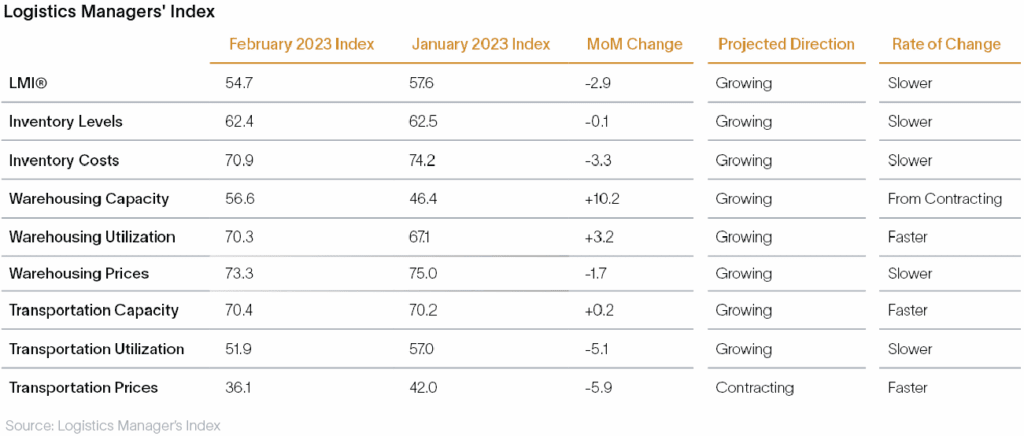
Logistics Managers’ Index (LMI)

Last month, the index declined despite huge warehouse capacity and utilization boosts. Inventory levels declined slightly, as did inventory costs and warehousing prices.

Graph 2-1_2023-03-14-221331_tmms

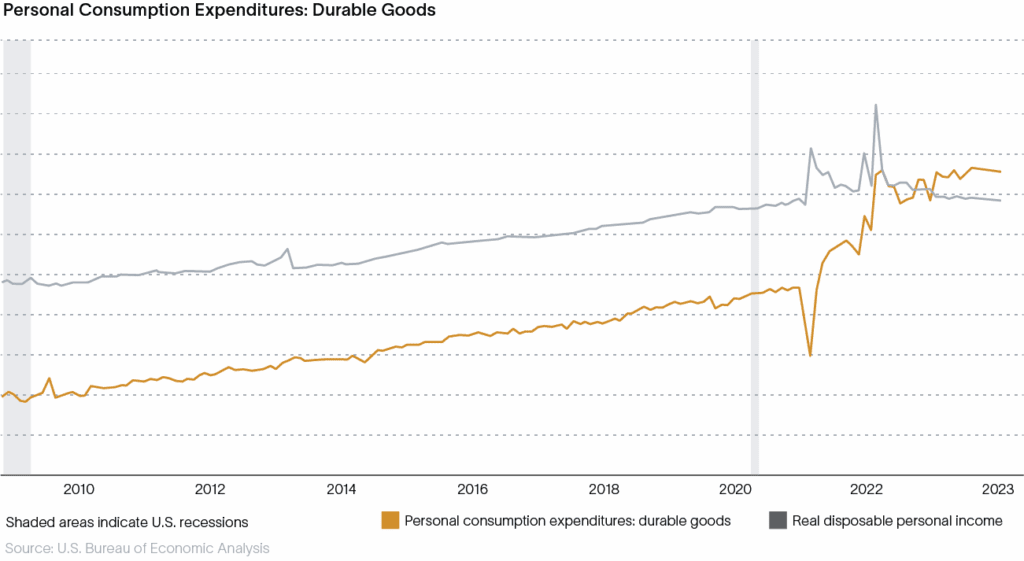
Disposable Income vs. Durable Goods Spend

This month’s data shows that personal consumption rose, while disposable income fell. Continued consumption predicts the need for logistics services. But the continued decrease in disposable income will lead to less consumption.

Graph 4-1 2023-03-14 221409 gmzf

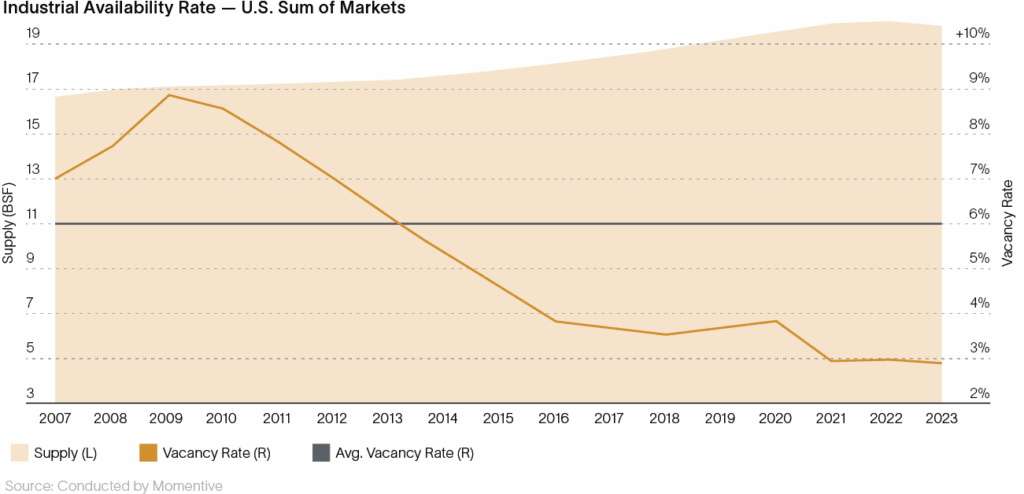
Industrial Real Estate Vacancy Rate

The lower the rate, the more difficult it is to find warehousing, distribution and fulfillment space. While some firms report 4%, CBRE cites an all-time low of 2.9%. CBRE will release its quarterly figure next month.

Graph 3-1

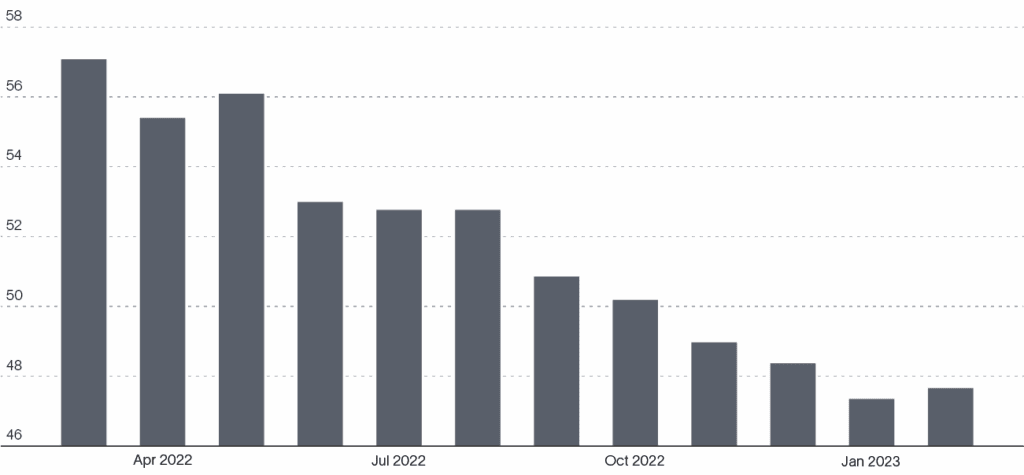
US Manufacturing Purchasing Managers’ Index

The index captures industrial output in the country during a given period. Like durable goods consumption, it provides context for demand forces: The higher the manufacturing index, the more volume enters logistics networks.
The index jumped again in February, indicating economic growth.

Graph 1-1 2023-03-14 221503 acpq

Warehouse Solutions

Transform your supply chain with an asset-light, agile approach

Save OpEx with Flexe

Stop overpaying. Calculate estimated savings by switching from rigid long-term leases to a pay-as-you-go model.

How It Works

A Dynamic Business Needs a Dynamic Supply Chain

Flexible Warehouse Network

Instantly find locations and specialized providers to optimize your inventory and handle the unpredictable.

Market Insights

Supply Chain Intelligence

Access market trends, vacancy rates, site costs, and capabilities to pinpoint your next strategic move.

Who We Are

Subscribe to
Flexe Resources

Get new posts delivered to your inbox.

Sign up to be part of the Flexe Logistics Network. Flexe Resources