Flexe Discover: Find warehouse capacity, benchmark pricing and prove ROI. Explore Now
Articles

Third-Party Warehouse Services or a Flexible Warehouse?

Third-party warehouse services fit steady, multi-year volume. A flexible warehouse fits peaks, overflow, and launches. Search the Flexe Warehouse Marketplace.
Pallets of wrapped boxes in front of tall orange and blue warehouse racking, with the Flexe logo and the headline Third-Party Warehouse or Flexible Warehouse?
Put the volume you can count on all year under a multi-year contract. Put the swing in flexible space. The breakeven math shows where the line falls.

Key Takeaways

  • Third-party warehouse services fit steady, high-volume demand on a multi-year contract
  • A flexible warehouse fits peaks, overflow, heavy and bulky goods, and short-term needs
  • The 80/20 Rule keeps about 80% as a fixed baseline and about 20% as a flexible buffer

Choose multi-year third-party warehouse services for volume that stays steady for years. They also fit when you need automation or dedicated labor built around your product. Choose a flexible warehouse when a need doesn’t justify a multi-year commitment. That includes seasonal peaks, overflow, heavy or bulky palletized goods, new markets, and the gap until a new lease or build is ready. Most networks need both: a fixed baseline and a flexible buffer.

So how much of your current contract covers volume that is unpredictable for any reason, seasonal peaks or the unexpected?

Many planners treat the third-party contract as the default and flexible space as the emergency backup. That habit has a cost. A contract sized to peak charges you for peak all year.

This guide gives you a way to sort each capacity need into multi-year or flexible terms. You’ll get a decision table, a breakeven formula to run before your next renewal, and the 80/20 Rule to split the two.

What’s the Difference Between Third-Party Warehouse Services and a Flexible Warehouse?

Third-party warehouse services are storage and handling run by an outside warehouse operator in its own building, usually under a multi-year contract. A flexible warehouse lets you add space where and when you need it, then release it. You pay only for the space and duration you use, with no multi-year commitment.

The difference is commitment length. Unlike 3PLs, which typically require multi-year contracts for specific locations, a flexible model lets you match space to the months you need it. Both models store pallets and ship orders. They just price time differently.

Factor Multi-year third-party contract Flexible warehouse
Commitment Multi-year term, typically with space or volume minimums Pay only for the space and duration you use
Time to start 6 to 9 months for a traditional implementation Go live in under 30 days with Flexe
Pricing Usually lower per pallet, but you pay for committed space whether it’s full or not Can run higher per pallet, but you pay only for the space and months you use
Best for Steady, predictable volume Seasonal peaks, overflow, heavy or bulky palletized goods, project staging, product launches, and bridges until a new DC opens

For an overview of the flexible side, see how flexible warehousing solutions fit into a network.

Fixed or Flexible Capacity? A Decision Table for Each Capacity Need

Sort each capacity need by two questions: how steady is the volume, and how long will you need the space? Steady, predictable needs fit a multi-year contract. Swings, short-term needs, and anything uncertain belong in flexible space.

Your situation Multi-year contract Flexible warehouse Why
Volume stable and predictable for the full contract term ✓ Lower per-pallet rate pays off when the space stays full
Custom automation or dedicated labor for your product ✓ The setup cost needs years to earn back
Volume swings by season or promotion ✓ Pay for the peak only while it lasts
Overflow above your DC’s practical capacity ✓ Protects the main building’s throughput
Entering a new or unproven market ✓ (first) Test demand before you commit. Move to a multi-year contract once volume proves out
Bridging until a lease, build, or operator transition lands ✓ The need has an end date
Heavy or bulky palletized goods ✓ Removes operational friction in automated facilities for specialized products.
Space needed within weeks ✓ Go live in under 30 days
Specialized storage (food grade, temperature, bonded) Either Either Screen fit first. Availability shifts with season and demand

When Third-Party Warehouse Services Are the Right Call

We recommend a multi-year contract when there isn’t much variability in your demand cycles and you can forecast it with confidence for the full term. It should also fill the space most of the year. The lower rate per pallet wins because you use every month you pay for.

A multi-year contract also wins when you need the site built around your product. Pick modules, specialized conveyors, and a trained crew take time and money to set up. A multi-year term gives the operator a reason to invest and gives you a rate that reflects it.

When a Flexible Warehouse Is the Right Call

Choose flexible space when a need doesn’t justify a multi-year commitment. Some needs are time-bound: seasonal peaks, promotions, project staging, or a bridge until a new DC opens. Some are uncertain: a new market, a forecast miss, or an import surge ahead of a tariff. Some come down to the product: heavy or bulky palletized goods that slow down an automated building. Overflow storage above your main DC’s capacity is one of the most common cases.

Most warehouses run best at about 85% of capacity, according to Oracle NetSuite’s guide to calculating warehouse capacity. Above that, picking slows and restocking falls behind.

Take a hypothetical DC with 10,000 pallet positions, so about 8,500 is its practical limit. The holiday inventory build peaks at 9,700 pallets for three months, which leaves 1,200 pallets over the limit.

Storage rates per pallet per month, handling excluded. The 12-month rate is hypothetical. The flexible rate is the October 2026 Flexe Spot Warehousing Index national rate.

Option Calculation Cost
12-month term: 1,200 positions at $10 1,200 × 12 × $10 $144,000
Flexible space: 1,200 positions for 3 months at $13.43 1,200 × 3 × $13.43 $48,348

The flexible rate is about 34% higher per pallet, but the total is still about $95,700 lower. The 12-month term charges $108,000 (1,200 × 9 × $10) for the nine months of empty space. That’s Dead Air: capacity you pay for and don’t use.

Before you add space, ask your current operator. It may have room in a building that already handles your product and connects to your systems. If so, compare its total cost for those months with the flexible total. Treat that as one data point, not the decision. Also weigh the term length, the site’s location, and whether it can take your full peak when you need it. Flexible space is often the better fit if the operator has no room in the market you need, or requires a longer term than the need lasts.

Find Space for the Volume Your Contract Shouldn’t Carry

Search and compare 1,100+ operators across 3,500+ locations against your own requirements, before any RFP.

Search the Network

Run the Breakeven Math Before You Sign

The breakeven point is the number of months a year at which fixed and flexible capacity cost the same. Below it, flexible capacity costs less in total. Above it, fixed capacity does.

Breakeven Months = 12 × (Multi-Year Rate ÷ Flexible Rate)

Multi-Year Rate is the monthly rate per pallet under a multi-year contract. The math looks at one year of the contract. Flexible Rate is the monthly rate per pallet for flexible space.

What the formula covers, and what it doesn’t

The formula compares storage cost only. It assumes the same pallet count in both options and a 12-month minimum paid in full. It leaves out costs that can change the answer:

  • Handling and labor: receiving, picking, and shipping fees
  • Transportation: transfer freight between sites, plus inbound and outbound freight
  • Location: distance to your customers or port of entry
  • Special requirements: temperature control, food grade, bonded storage, or other certifications
  • One-time costs: onboarding and system setup

These costs can push the result in either direction. Use breakeven as a starting point, not the final answer.

The formula also assumes committed space: space you pay for whether you use it or not. If your multi-year contract bills per pallet or has a lower seasonal minimum, run the formula on the space you actually commit to.

The math shows one year. On a multi-year contract, the same comparison repeats each year of the term. That assumes your peak, volume, and rates hold steady. If they change, run the formula for each year.

With a hypothetical $10 multi-year rate and the October 2026 Flexe Spot Warehousing Index national rate of $13.43, breakeven is 12 × (10 ÷ 13.43) = 8.9 months. The index rate is a national average. Your peak season quote in your market may run higher. A higher flexible quote lowers breakeven, so use the peak-season quote for the months you’d use flexible space, not an annual average. At those rates, the two options for 1,000 pallets cost about the same at nine months.

Months needed per year (storage only) Flexible cost (1,000 pallets) Multi-year cost (1,000 pallets, 12-month minimum) Lower total
2 $27K $120K Flexible
4 $54K $120K Flexible
6 $81K $120K Flexible
8 $107K $120K Flexible
9 $121K $120K Even
10 $134K $120K Multi-year
12 $161K $120K Multi-year

Take a hypothetical manufacturer bridging six months until a new DC opens. At these rates, six months sits about three months under the roughly nine-month breakeven, so the bridge leans flexible. Recheck it after adding onboarding and transfer freight costs.

Run it with real numbers before you renew third-party warehouse services or add flexible space. For the flexible side, benchmark against current warehouse storage rates in the Flexe Spot Warehousing Index.

Once you have your storage breakeven, add the other costs to each side. Onboarding and transfer freight usually land on the flexible side. Then compare the gap in dollars, not months. At these rates, a four-month need for 1,000 pallets saves about $66,000 in storage. The other costs would have to top that to change the answer. A six-month need saves about $39,000, so the margin is thinner and worth a closer check.

When a Contract Sized to Peak Costs You

A multi-year contract for third-party warehouse services costs you when you size it to your busiest weeks. The space you pay for in the quiet months is Dead Air.

The risk grows with the term. A three-year contract sized to one year’s peak is a bet that the forecast holds for three years. In the overflow example above, the nine empty months cost $108,000 in one year. If the same peak repeats on a three-year term, that’s $324,000 in Dead Air. That’s the Fixed-Lease Trap, and it applies to third-party contracts as much as full building leases. If volume drops or shifts to another region, the minimums typically stay.

Flexible space has its own trade-off. For steady, year-round volume, a multi-year contract usually costs less per pallet.

The breakeven table shows it: at 12 months, the hypothetical flexible option costs about $41,000 more.

That premium can be worth paying. A one- or two-year flexible term lets you test a location before you commit to a multi-year agreement. Once volume proves out, move the steady base to a multi-year contract.

For most networks, the answer is both. The question is where to draw the line between them.

Use Both: Split Third-Party Warehouse Services and Flexible Space with the 80/20 Rule

We recommend the 80/20 Rule to draw that line. Keep about 80% of capacity as a fixed baseline: long-term leases or dedicated 3PL facilities. Run about 20% as a flexible buffer for seasonal peaks, overflow, and short-term regional swings. The baseline stays full enough to earn the multi-year rate. The buffer costs less in flexible space when it runs fewer months than breakeven.

The 80/20 Rule is the reference split. The breakeven test decides where each block of volume goes, so the example below lands near 80% rather than on it. Freight already works this way, according to DAT Freight & Analytics: 80 to 90% of freight moves under contract. The spot share moves with the market: about 13% of truckload freight before the pandemic, and as much as 25% at times in 2021.

Take a hypothetical CPG brand that peaks at 2,600 pallet positions. About 2,000 positions stay full all year. The other 600 fill for four months. That puts the steady base at about 77% of peak, close to the 80/20 split.

Storage rates per pallet per month, handling excluded. The 12-month rate is hypothetical. The flexible rate is the October 2026 Flexe Spot Warehousing Index national rate.

Plan Calculation Annual cost
Multi-year contract all 2,600 positions at $10 2,600 × 12 × $10 $312,000
Multi-year contract 2,000 at $10, plus flexible space: 600 at $13.43 (2,000 × 12 × $10) + (600 × 4 × $13.43) $272,232

The split runs about $39,800 lower in this example, and the multi-year contract still carries most of the volume. The example keeps the $10 rate on the smaller commitment. A smaller commitment can carry a higher rate, so get a re-quote for 2,000 positions and run the split on that number.

Long-term relationships stay central in this model. NTT DATA’s 2027 Third-Party Logistics Study found shipper-3PL partnerships are stronger and more strategic, with a growing focus on agility. The 80/20 Rule keeps those partnerships focused on the volume they price best. For the full framework, see the 80/20 warehouse network.

Fit Still Comes First, Whichever Model You Choose

A low rate doesn’t help if the site can’t handle your product. Screen fit before you compare rates, whether you contract for third-party warehouse services or add flexible space.

Check these before you ask for a quote:

  1. Product profile: size, weight, and whether pallets can stack
  2. Handling unit: pallet in and pallet out, or carton and each picks
  3. Storage and certifications: racked, bulk, or temperature-controlled space, plus any certifications you need (food grade, FDA registration, bonded)
  4. Location: distance to customers or your port of entry
  5. Peak capacity: whether the site can take your swing in the months you need it
  6. Systems: how the operator connects to your order and inventory data

Availability changes with the time of year and with supply and demand. As of October 2026, the Flexe Spot Warehousing Index put national vacancy at 7.2% and called it a Neutral Market. Check the latest edition before you assume space is easy or hard to find, especially for certified, temperature-controlled, or bonded storage.

For the flexible buffer, the Flexe Warehouse Marketplace lets you run that screen yourself. Enter a location or port of entry, how much storage you need, and how far you’ll search. Then filter by:

  • Food Grade
  • Racked Storage
  • Bulk Storage
  • Secured Access
  • Pest Control Program

Search shows where capacity exists today. A Flexe logistics expert confirms availability for your dates. From there, Flexe’s teams handle scoping, sourcing and bidding, onboarding, and day-to-day operations as part of Flexe’s managed warehouse services.

Adding sites can slow you down if each one needs its own system connection. Every operator in the Flexe Logistics Network runs on Flexe’s WMS, so one connection reaches every warehouse you add. Connect by API, EDI, XML, or CSV upload. Learn how Flexe’s WMS integration works the same at every site.

Frequently Asked Questions

Is a Flexible Warehouse Cheaper than a Multi-year Contract?

Whether a flexible warehouse costs less depends on how many months you need the space. Flexible space can cost more per pallet, but it costs less in total when the need runs fewer months than breakeven. Divide the multi-year rate by the flexible rate and multiply by 12 to find your breakeven months.

Can I Keep My Current 3PL and Add Flexible Space for Peak?

Yes. Keep your 3PL contract for your steady base and add flexible space for the swing above it. That’s the 80/20 Rule: about 80% of capacity as a fixed baseline and about 20% as a flexible buffer. Your incumbent keeps the volume it prices best, and you stop paying for peak space all year.

How Fast Can I Add a Flexible Warehouse?

With Flexe, you can go live in under 30 days. By comparison, a traditional implementation takes 6 to 9 months, and traditional site selection alone takes 60–90 days at minimum. Speed depends on how complete your scope is and how quickly your item data and connection are ready.

How Do I Choose a 3PL Provider?

Choose a 3PL provider on fit first, then rate. Confirm the operator can handle your product profile and handling unit. Then check certifications, storage type, and location.

Next, run the breakeven math on the volume you plan to commit. If any part of that volume runs fewer months than breakeven, keep it off the multi-year contract and use flexible space instead.

What’s the Difference Between Contract Warehousing and Third-Party Warehouse Services?

Contract warehousing is one kind of third-party warehouse service. An outside operator runs space or labor dedicated to one shipper under a multi-year agreement. Other third-party warehousing companies run multi-client buildings and price per pallet. Either way, run the breakeven math before you sign.

Do I Need a New Integration for Each Flexible Warehouse?

Not with Flexe. With other providers, each new warehouse operator may need its own integration. Every operator in the Flexe Logistics Network runs on Flexe’s WMS, so one connection works for every warehouse you add. If you keep your current operator, its connection stays as is. You add one Flexe connection, and it covers every flexible site after that. You can connect by API, EDI, XML, or CSV upload.

Sort Your Volume Before the Next Renewal

Before you renew or sign third-party warehouse services, split your volume into two numbers. The steady base goes on a multi-year contract. The swing goes through the breakeven formula, and anything under breakeven goes to flexible space.

The same split works beyond renewals. A new market, a product launch, and a DC that opens six months late are all needs that don’t justify a multi-year commitment. Each one is a case for flexible space on top of a fixed baseline, sized to the 80/20 Rule.

Find Space That Fits the Swing

Search and compare 1,100+ operators across 3,500+ locations. A Flexe logistics expert confirms capacity, and Flexe’s teams handle onboarding and implementation.

Search the Network

Article

The Guide to Fixed and Flexible Warehousing

Pallet racking full of boxes on the left blends into a delivery van at a warehouse bay door on the right, with the Flexe logo and the headline Fixed and Flexible Warehousing in the center
Article

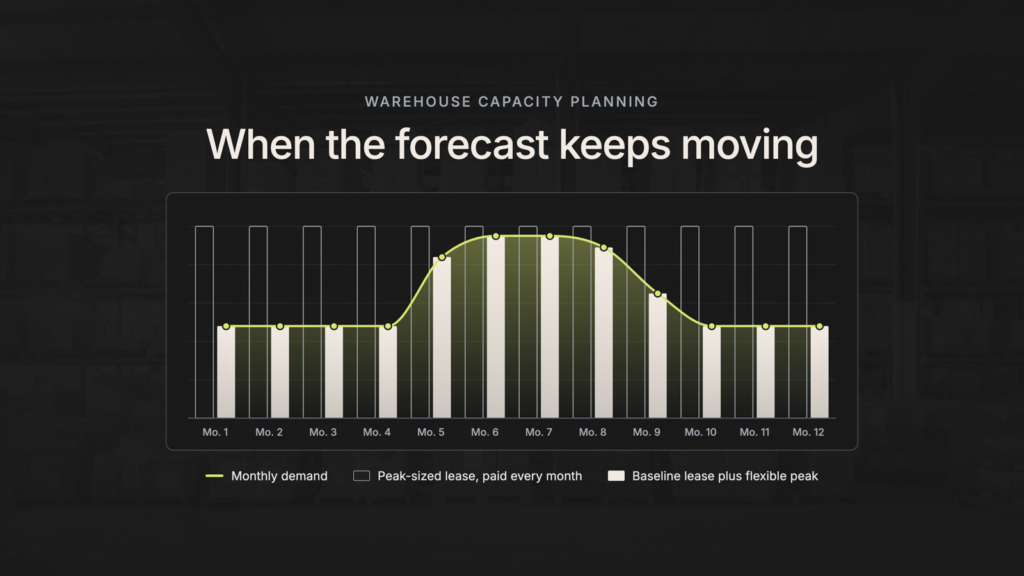
Warehouse Capacity Planning When the Forecast Keeps Moving

Warehouse Capacity Planning When the Forecast Keeps Moving

Warehouse Solutions

Transform your supply chain with an asset-light, agile approach

Discover

North America’s Largest Flexible Warehousing Network

Find Flexible Rates, Space, and Terms.

Instantly find locations and specialized providers to optimize your inventory and handle the unpredictable.

How It Works

A Dynamic Business Needs a Dynamic Supply Chain

Resources

Research, Insights, and Proven Results

Who We Are

Subscribe to
Flexe Resources

Get new posts delivered to your inbox.

Sign up to be part of the Flexe Logistics Network. Flexe Resources