North America’s Largest Flexible Warehousing Network
3,500+ warehouses. No leases. Just the space you need.
The pricing benchmark for short-term, on-demand warehousing, updated monthly.
See your estimated savings with pay-as-you-go warehousing.
Instantly find locations and specialized providers to optimize your inventory and handle the unpredictable.
Research, Insights, and Proven Results
By Caroline Thomas, Principal Product Marketer
Last updated: April 5, 2027
Beverage warehouse capacity for summer is best planned the autumn before. Put a flexible capacity line in next year’s budget, line up certified space by December, and start the inventory build in January. Plan for a July handling peak and set an exit date after Labor Day.
How much of your network do you size for four months of the year? A seasonal peak runs on a repeating cycle. One national CPG manufacturer built inventory ahead of its summer peak, then shipped through the season. For the rest of the year, it needed little or no extra space.
That cycle splits the work between two roles. The business planner sets the fixed baseline and builds the flexible line into the budget. The warehouse planner finds the space, onboards it, and gets product out the door at peak. This plan covers both jobs, plus what you can still fix in April.
Peak beverage season runs from Memorial Day to Labor Day, and inventory builds for months before it. In 2027, Memorial Day falls on May 31, July 4 lands on a Sunday, and Labor Day is September 6. Those three weekends set the outbound calendar.
The inventory curve starts much earlier. Plants typically run ahead of demand through winter and spring because production can’t match summer sell-through week for week. A plant usually can’t hold that extra product on site either. The build needs a secondary location near the plant or the customers it serves.
Those two peaks don’t land in the same month. Inventory typically tops out in June, just before the holiday weekends pull it down. Outbound handling tops out in July, when the most product moves through the fewest days.
A plan that only counts square feet will miss the second peak. For the first peak, see how flexible beverage warehousing for seasonal inventory absorbs the build.
[image: line chart by month, January to December. One line shows pallets on the floor, rising from January and peaking in June. A second line shows outbound handling, peaking in July. Memorial Day, July 4, and Labor Day marked.]
Caption: Beverage inventory typically peaks on the floor in June, and outbound handling typically peaks in July.
We recommend planning it in September and October, during the budget build for the following year. By then, last summer’s actuals are in. A flexible capacity line, the budget for space beyond your fixed baseline, can still go into the plan. Wait until spring, and you make the same decision under time pressure.
The summer cycle runs in three phases. This table is our planning view of who does what in each one, not a rule for every brand.
| Phase | Months | What happens | Business planner | Warehouse planner |
|---|---|---|---|---|
| Build | Jan–Apr | Production runs ahead of demand, and inventory builds in a secondary location | Checks the build against the budget in the monthly supply review | Sources certified space, sets inbound schedules, and adds space as overflow starts |
| Peak | May–Aug | Retail distribution from Memorial Day through Labor Day; floor peak in June, handling peak in July | Tracks cost against the plan | Locks docks, labor, and added shifts by April, then ships the July peak |
| Depletion | Sep–Dec | Peak inventory depletes, and little or no extra space is needed | Sets next year’s fixed baseline and flexible capacity line in the budget | Releases flexible sites and reconciles cost against the plan |
Why start in autumn? The budget locks then, and traditional site selection alone takes 60–90 days at minimum. Wait until March, and the January build is already under way.
Check spot rates, vacancy, and demand by region before you put a number in next year’s plan.
The business planner works years out, deciding how much of the network stays fixed and what the budget allows for everything above it. Summer is where that split gets tested.
We recommend the 80/20 warehouse network as a starting point. Keep about 80% of capacity as a fixed baseline (long-term leases or dedicated 3PL facilities). Run about 20% as a flexible buffer for seasonal peaks, overflow, and short-term regional swings.
The split isn’t a law. A brand with a sharper curve may put more in flexible space, and a brand with flat demand may put in less. The point is to size fixed beverage warehouse capacity to your baseline on purpose, not to your best week by default.
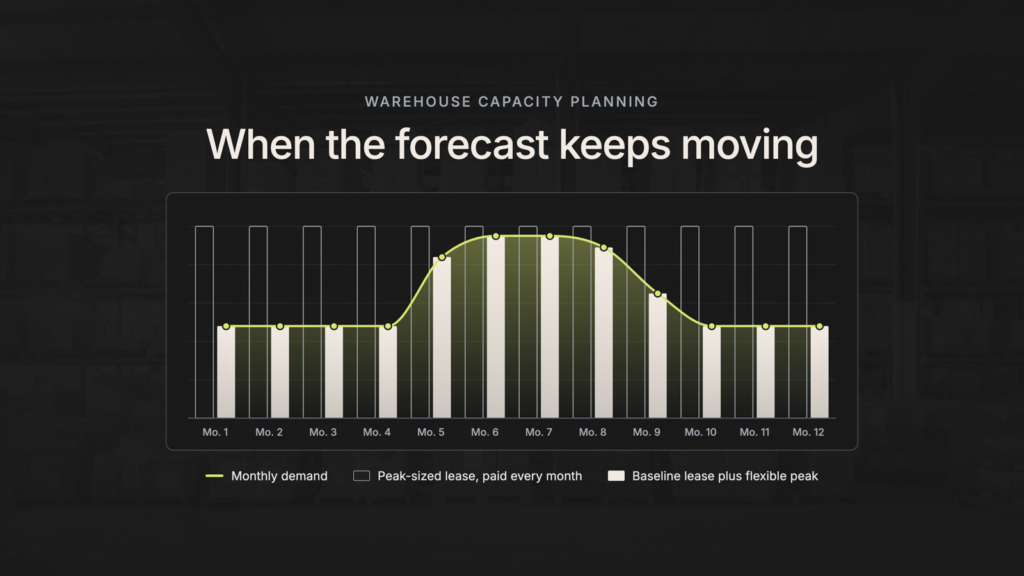
We recommend a fixed baseline for the volume you carry all year and flexible space for the summer build. A lease sized for June carries the June peak for 12 months. Overflow warehouse space carries it only while the pallets are there.
Paying for that peak all year creates Dead Air: paid-for, unused capacity in a lease sized for peak.
Take a hypothetical brand with 8,000 pallet positions. Industry guidance puts practical warehouse capacity at about 85% according to Oracle NetSuite. Above the line, or 6,800 pallets here, picking slows restocking falls behind, so every pallet past it is overflow. From February through August, its overflow runs 300, 1,200, 2,100, 2,800, 3,300, 2,200, and 600 pallets, peaking at 3,300 in June. Added together, that comes to 12,500 pallet-months: one pallet stored for one month is one pallet-month. A lease sized for the June peak pays for 3,300 positions for 12 months, or 39,600 position-months. The seasonal inventory build uses 12,500 of them, about 32%. The other 68% is Dead Air, and most of it sits from September through January.
If your current warehouse operator has room in the months you need at a workable rate, that works too. Take your overflow projection into that conversation.
Compare only the extra space you need to meet the peak. Your fixed baseline costs the same either way, so leave it out.
This comparison covers storage only. It leaves out costs that can push the result in either direction:
The Flexe Spot Warehousing Index national rate was $13.43 per pallet per month as of October 2026, down 5.0% from September. Use the current edition, and check the Flexe Spot Warehousing Index Regional Index where your volume lands. The Index prices a standard ambient pallet, stackable 2-high, so confirm food-grade quotes. The flexible row prices the 12,500 pallet-months of overflow from the hypothetical above.
| Option for the extra summer space (hypothetical, storage cost only) | Billed volume | Rate (per pallet per month) | Storage cost |
|---|---|---|---|
| Lease sized for June | 39,600 position-months (3,300 x 12) | $9.00 (hypothetical fixed rate) | $356,400 |
| Flexible space for pallets above the usable line | 12,500 pallet-months (Feb-Aug) | $13.43 (Index, October 2026) | $167,875 |
The lease row assumes full use. Holding it to the same 85% line would take about 3,900 positions. To test a lease quote, divide the flexible space total by the lease’s 39,600 position-months. That gives your break-even rate per position-month. If the lease quote comes in below that rate, the lease costs less.
Flexible space can cost more per pallet than a long lease. For seasonal volume like this, it can still cost less in total. With Flexe, you pay only for the space and duration you use, with no long-term lease.
In October 2026, the national industrial vacancy rate was 7.2%, according to CoStar. The Flexe Spot Warehousing Index rated demand intensity as moderate and called the market neutral. National figures can hide regional swings. Check conditions in your region against your product’s storage requirements before you commit.
Compare your current rate and footprint with the latest monthly Index before you renew or sign.
The warehouse planner turns the budget line into pallets, sites, and shifts, often on a shorter clock. The work starts with one number: how many pallets won’t fit.
Convert your peak month’s forecast to pallets, one product family at a time. Divide units by units per case, then by cases per pallet, and round up.
Take a hypothetical brand that forecasts 19.4 million cans on the floor in June. Packed 24 to a case, that’s about 808,000 cases. At 80 cases per pallet, it’s about 10,100 pallets.
Industry guidance puts practical warehouse capacity at about 85%, according to Oracle NetSuite. Above that, picking slows and restocking falls behind. So a building with 8,000 pallet positions has a usable line of about 6,800 pallets. Anything above it is overflow.
Run the same math for every month of the build:
| Month | Jan | Feb | Mar | Apr | May | Jun | Jul | Aug | Sep |
|---|---|---|---|---|---|---|---|---|---|
| Projected pallets on floor (hypothetical) | 6,200 | 7,100 | 8,000 | 8,900 | 9,600 | 10,100 | 9,000 | 7,400 | 6,300 |
| Overflow pallets (above the 6,800 usable line) | 0 | 300 | 1,200 | 2,100 | 2,800 | 3,300 | 2,200 | 600 | 0 |
[image: bar chart of the hypothetical monthly overflow pallets above the 6,800 usable line, February through August, peaking at 3,300 in June.]
Caption: In the hypothetical, overflow peaks at 3,300 pallets above the 85% line in June.
Overflow peaks at 3,300 pallets in June. Adding up the overflow row gives 12,500 pallet-months across the season. The peak sizes the space, and the pallet-months price it.
To convert to floor space, state your density basis. For this hypothetical, assume 8–12 square feet of gross building per position, then check your own layout. At that rate, 3,300 positions come to roughly 26,000–40,000 square feet.
Lock down five inputs by December so space is ready when overflow starts. Beverage space has a narrower fit than general storage, and certification gaps are a common reason a site isn’t ready when the build is.
Beverage warehouses hit two peaks each summer. Stored inventory peaks in June. Outbound volume peaks in July, and July also loses shipping days to the Fourth of July holiday.
The July peak tests docks and labor, not storage capacity. A building with open pallet positions can still miss shipments if it runs out of dock doors or shifts. To size it, divide July’s outbound pallets by its shipping days. Then compare that number with how many pallets your doors and crews can load in a day.
Plan July in April, before seasonal labor and carrier capacity typically tighten. That means approving added shifts and enough dock capacity for the outbound peak. If the fixed baseline can’t handle July’s volume, a flexible site can take part of the outbound load, not just the storage.
If you start now, you can still search for overflow warehouse space for this summer. Start with the overflow math for May, June, and July only.
You can find warehouse space in the Flexe Warehouse Marketplace, which spans 1,100+ operators across 3,500+ locations. Filter by Food Grade, Racked Storage, and more. Search results aren’t live availability, so a Flexe logistics expert confirms capacity before you commit.
From there, Flexe’s teams handle the rest in sequence. A solutions team scopes the need, an implementation team sets up the site, and the operations team runs it day to day. With capacity confirmed, you can go live in under 30 days.
Decide when each flexible site releases before the first pallet arrives. Tie release dates to the burn-down in your overflow projection, so space leaves when the inventory does. In the hypothetical, overflow drops to 600 pallets in August and to zero in September.
After Labor Day, reconcile what you paid against the plan. That reconciliation becomes the business planner’s first input to next autumn’s beverage capacity planning, and the cycle starts again.
You release each site on the dates you set before the build, timed to when your projected overflow reaches zero.
You can search for Food Grade space in the Flexe Warehouse Marketplace. A Flexe logistics expert confirms capacity for your dates before you commit.
Not with Flexe. You integrate once, and it works for every operator in the Flexe Logistics Network. A few months of space doesn’t necessarily need its own integration project. You can use a CSV upload, which doesn’t require an integration, or choose one or any combination of API, EDI, and XML.
Not necessarily. With capacity confirmed, you can go live in under 30 days, so April can leave time before July’s handling peak.
Put next summer’s beverage warehouse capacity into this autumn’s budget as a flexible capacity line, sized from your own overflow projection. The math is the same every year: forecast to pallets, pallets to overflow, overflow to cost. What changes is whether you decide it in October or scramble for it in May.
Check regional rates, vacancy, and demand in the latest monthly Index.
North America’s Largest Flexible Warehousing Network
3,500+ warehouses. No leases. Just the space you need.
The pricing benchmark for short-term, on-demand warehousing, updated monthly.
See your estimated savings with pay-as-you-go warehousing.
Instantly find locations and specialized providers to optimize your inventory and handle the unpredictable.
Research, Insights, and Proven Results
Get new posts delivered to your inbox.